Early years (1897–1945)
Real Madrid s origins go back to when football was introduced to Madrid by the academics and students of the
Institución libre de enseñanza, which included several
Cambridge and
Oxford University graduates. They founded
Football Club Sky in 1897, playing on Sunday mornings at Moncloa. It split into two clubs in 1900:
New Foot-Ball de Madrid and
Club Español de Madrid.
[10] On 6 March 1902, after a new Board presided by
Juan Padrós had been elected, Madrid Football Club was officially founded.
[3] Three years after its foundation, in 1905,
Madrid FC won its first title after defeating
Athletic Bilbao in the
Spanish Cup final. The club became one of the founding sides of the
Royal Spanish Football Federation on 4 January 1909, when club president
Adolfo Meléndez signed the foundation agreement of the Spanish FA. After moving between grounds the team moved to the
Campo de O'Donnell in 1912.
[11] In 1920, the club's name was changed to Real Madrid after
King Alfonso XIII granted the title of
Real (Royal) to the club.
[12]
In 1929, the first
Spanish football league
was founded. Real Madrid led the first league season until the last
match, a loss to Athletic Bilbao, meant they finished runners-up to
Barcelona.
[13] Real Madrid won its first League title in the
1931–32 season. Real won the League again the following year, becoming the first side to have won the championship twice.
[14]
On 14 April 1931, the arrival of the
Second Spanish Republic
caused the club to lose the title Real and went back to being named
Madrid Football Club. Football continued during the Second World War,
and on 13 June 1943 Madrid beat
Barcelona 11–1 in the second leg of a semi-final
[15] of the
Copa del Generalísimo, the Copa del Rey having been renamed in honour of
General Franco. It has been suggested that Barcelona players were intimidated by police,
[16]
including by the director of state security who "allegedly told the
team that some of them were only playing because of the regime's
generosity in permitting them to remain in the country."
[17](p26) The Barcelona chairman, Enric Piñeyro, was assaulted by Madrid fans.
[18](p284)
Santiago Bernabéu Yeste and European success (1945–1978)
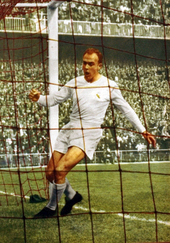
Alfredo Di Stéfano, led the club to win five European Cups consecutively (currently, the Champions League)
Santiago Bernabéu Yeste became president of Real Madrid in 1945.
[19] Under his presidency, the club, its stadium
Santiago Bernabéu and its training facilities
Ciudad Deportiva were rebuilt after the
Spanish Civil War damages. Additionally, during the 1950s former
Real Madrid Amateurs player Miguel Malbo founded Real Madrid's youth academy, or "
cantera", known today as
La Fábrica.
[20] Beginning in 1953, he embarked upon a strategy of signing world-class players from abroad, the most prominent of them being
Alfredo Di Stéfano.
[21]
In 1955, acting upon the idea proposed by the French sports journalist and editor of
L'Équipe Gabriel Hanot, Bernabéu, Bedrignan and
Gusztáv Sebes created an exhibition tournament of invited teams from around Europe that would eventually become what today is known as the
UEFA Champions League.
[22]
It was under Bernabéu's guidance that Real Madrid established itself as
a major force in both Spanish and European football. The club won the
European Cup five times in a row between 1956 and 1960, which included
the 7–3 Hampden Park
final against
Eintracht Frankfurt in
1960.
[21] After these five consecutive successes, Real was permanently awarded the original cup and earning the right to wear the
UEFA badge of honour.
[23] The club won the European Cup for a sixth time in
1966 defeating
Partizan Belgrade 2–1 in
the final with a team composed entirely of same nationality players, a first in the competition.
[24] This team became known as the
Yé-yé. The name "Ye-yé" came from the "Yeah, yeah, yeah" chorus in
The Beatles' song "
She Loves You" after four members of the team posed for
Diario Marca dressed in Beatles wigs. The Ye-yé generation was also European Cup runner-up in
1962 and
1964.
[24]
In the 1970s, Real Madrid won five league championships and three Spanish Cups.
[25] The club played its first UEFA Cup Winners' Cup final in 1971 and lost to English side Chelsea 2–1.
[26] On 2 July 1978, club president Santiago Bernabéu died while the
World Cup was being played in
Argentina.
The International Federation of Association Football (FIFA) decreed
three days of mourning to honour him during the tournament.
[27] The following year, the club organized the first edition of the
Trofeo Santiago Bernabéu in the memory of its former president.
Quinta del Buitre and seventh European Cup (1980–2000)
By the early 1980s, Real Madrid had lost its grasp on the
La Liga title until a new batch of home-grown stars brought
domestic success back to the club.
[28] Spanish sport journalist Julio César Iglesias gave to this generation the name
La Quinta del Buitre ("Vulture's Cohort"), which was derived from the nickname given to one of its members,
Emilio Butragueño. The other four members were
Manuel Sanchís,
Martín Vázquez,
Míchel and
Miguel Pardeza; all five footballers were graduates of
Real Madrid's youth academy.
[29] With
La Quinta del Buitre (reduced to four members when Pardeza left the club for
Zaragoza in 1986) and notable players like goalkeeper
Francisco Buyo, right-back Miguel Porlán
Chendo and Mexican striker
Hugo Sánchez, Real Madrid had one of the best teams in Spain and Europe during the second half of the 1980s, winning two UEFA Cups, five
Spanish championships in a row, one Spanish cup and three
Spanish Super Cups.
[29] In the early 1990s,
La Quinta del Buitre split up after Martín Vázquez, Emilio Butragueño and Míchel left the club.
In 1996, President
Lorenzo Sanz appointed
Fabio Capello as coach. Although his tenure lasted only one season, Real Madrid was proclaimed league champion and players like
Roberto Carlos,
Predrag Mijatović,
Davor Šuker and
Clarence Seedorf arrived at the club to strengthen a squad that already boasted the likes of
Raúl,
Fernando Hierro,
Iván Zamorano, and
Fernando Redondo. As a result, Real Madrid (with the addition of
Fernando Morientes in 1997) finally ended its 32-year wait for its seventh European Cup. In 1998, under manager
Jupp Heynckes, The Whites defeated Juventus 1–0 in the final thanks to a goal from
Predrag Mijatović.
[30]
Los Galácticos (2000–2006)
For more details on this topic, see
Galáctico.

Beckham and Zidane were considered "Galácticos"
In July 2000,
Florentino Pérez was elected club president.
[31]
He vowed in his campaign to erase the club's 270 million euro debt and
modernize the club's facilities. However, the primary electoral promise
that propelled Pérez to victory was the signing of
Luís Figo.
[32] The following year, the club got its training ground rezoned and used the money to begin assembling the famous
Galáctico side including players such as
Zinédine Zidane,
Ronaldo,
Luís Figo,
Roberto Carlos,
Raúl,
Fabio Cannavaro and
David Beckham. It is debatable whether the gamble paid off, as despite a UEFA Champions League and an
Intercontinental Cup (football) win in 2002, followed by the League in 2003, the club failed to win a major trophy for the next three seasons.
[33]
In the summer of 2003, just after capturing another La Liga title,
Florentino Pérez and the board of directors refused to renew the
contract of coach
Vicente del Bosque and after an internal dispute forced captain
Fernando Hierro to leave the club. They also ignored
Claude Makélélé's
request of a new contract with a better salary, in return, Makélélé
asked for a transfer request, and was transferred to Chelsea.
[citation needed]
The few days after the capturing of the league title were surrounded
with controversy. The first controversial decision came when Perez
sacked winning coach Vicente del Bosque, after Real's sporting director
claimed that del Bosque was not the right man for the job; they wanted
someone young to shake up the team.
[citation needed]
The bad atmosphere continued when the Real legend and captain Fernando
Hierro left the club after a disagreement with the management, as did
Steve McManaman.
[citation needed] However, the club toured Asia in pre-season and introduced newly signed
David Beckham. Perez and his directors refused to renew
Claude Makélélé's contract with a better salary, upsetting Makelele who asked for a transfer, eventually moving to Chelsea F.C..
[citation needed] In the final days of the transfer window, Fernando Morientes left the club on loan to Monaco.
[citation needed] Real Madrid, with newly appointed coach Carlos Queiroz, started their domestic league slowly after a hard win over Real Betis.
[citation needed]
The 2005–06 season began with the promise of several new signings —
Julio Baptista (€20 Million),
Robinho (€30 Million) and
Sergio Ramos (€30 Million – Release Clause) —
[citation needed]
but the Portuguese coach was not able to find the right formula on the
pitch as Real Madrid's poor form continued, with the team hitting rock
bottom after a humiliating 0–3 loss at the hands of F.C. Barcelona in
the Santiago Bernabéu.
[citation needed] Luxemburgo would eventually resign and his replacement was
Juan Ramón López Caro, formally the manager of
Real Madrid Castilla.
[citation needed]
A brief return to form came to an abrupt halt after losing the first
leg of the Copa del Rey quarterfinal, 6–1 to Real Zaragoza.
[citation needed]
Shortly after, Real Madrid were eliminated from the Champions League
for a fourth successive year, this time at the hands of Arsenal. On 27
February 2006, Florentino Pérez resigned.
[34]
New president Ramón Calderón (2006–2009)
Ramón Calderón was elected as club president on 2 July 2006 and subsequently appointed Fabio Capello as the new coach and
Predrag Mijatović as the new sporting director. Real Madrid won the
La Liga title in 2007 for the first time in four years but Capello was sacked.
[35] On 9 June 2007, Real played against
Zaragoza at
La Romareda.
The match got off to a bad start when Real Madrid were forced to change
their lineup some minutes before the start of the match when young
defender
Miguel Torres tore his hamstring during warm-up.
[citation needed]
Zaragoza led Real 2–1 near the end of the match while Barcelona were
also winning against Espanyol 2–1. Real's title challenge looked to be
over.
[citation needed] However, a late
Ruud van Nistelrooy equalizer followed by a last minute
Raúl Tamudo goal sprang Real Madrid's title hopes back into their favour.
[citation needed] Sevilla were also held 0–0 away against
Mallorca, which meant that a win at home against Mallorca would effectively secure Los Merengues their 30th Spanish league title.
[citation needed]
The title was won on 17 June, Real faced Mallorca at the
Bernabéu, while
Barcelona and
Sevilla, the other title challengers, faced
Gimnàstic de Tarragona and
Villarreal respectively. At half time Real were 0–1 down, while Barcelona had surged ahead into a 0–3 lead in
Tarragona;
however, three goals in the last half-an-hour secured Real Madrid a 3–1
win and their first league title since 2003. The first goal came from
Reyes who scored after a good work from
Higuaín.
An own goal followed by another delightful goal from Reyes allowed Real
to begin celebrating the title. Thousands of Real Madrid fans began
going to
Plaza de Cibeles to celebrate the title.
[citation needed]
Second Pérez Term and the Mourinho era (2009–2013)

Cristiano Ronaldo, the first player ever to score against every team in a single season in La Liga.
On 1 June 2009, Florentino Pérez regained Real Madrid's presidency.
[36][37] Pérez continued with the
Galácticos policy pursued in his first term, buying
Kaká from
Milan,
[38] and then purchasing
Cristiano Ronaldo from
Manchester United for a record breaking £80 million.
José Mourinho took over as manager in May 2010.
[39][40] In April 2011, a strange occurrence happened, for the first time ever, four
Clásicos
were to be played in a span of eighteen days. The first fixture was for
the Liga campaign on 17 April (which ended 1–1 with penalty goals for
both sides), the
Copa del Rey
final (which ended 1–0 to Madrid), and the controversial two-legged
Champions League semifinal on 27 April and 2 May (3–1 loss on aggregate)
to Barcelona.
The first Clasico saw
Cristiano Ronaldo get his first goal against Barcelona due to a penalty given to Madrid after a foul to
Marcelo.
The Copa del Rey final gave Real Madrid its first title under Mourinho
with a header from Cristiano Ronaldo in extra time. The Champions League
semifinal was perhaps the most controversial of the four, with the
expulsion of
Pepe in the first leg at the Santiago Bernabéu, after an alleged "dangerous challenge" to Barcelona defender
Daniel Alves.
Alves was carried out in a stretcher "unable to walk", but after Pepe
was shown red, Alves came running back into the field within seconds.
After Pepe's sending off, coach José Mourinho was also sent off,
receiving a fine and a five-match ban. This same match was also
controversial in that Barcelona midfielder
Sergio Busquets being captured on video saying what seemed like a supposed racial slur to Madrid left-back
Marcelo. The second leg was not as controversial as the first, with perhaps the exception of an annulled goal to
Gonzalo Higuaín, after Cristiano Ronaldo was deemed to have fouled
Javier Mascherano as a result of a foul to Ronaldo by
Gerard Piqué.
[41]
In the 2011–12 La Liga season, Real Madrid won the league, a record
32nd time in La Liga history and finished the season with a number of
records including 100 points in a single season, a record 121 goals
scored & goal difference of +89, and a record 16 away wins and 32
overall wins.
[42]
In the same season, Cristiano Ronaldo become the fastest player to
reach 100 goals in Spanish league history. In reaching 101 goals in 92
games, Ronaldo surpassed Real Madrid legend
Ferenc Puskás,
who scored 100 goals in 105 games. Ronaldo set a new club mark for
individual goals scored in one year (60), and became the first player
ever to score against all 19 opposition teams in a single season.
[43][44]
Real Madrid began the 2012-13 season by winning the
Supercopa de España, defeating Barcelona on away goals, but finished as second in the
league competition. A major transfer of the season was signing of
Luka Modrić, in the region of £33 million. In the
Champions League,
they were drawn in the "group of death" along Borussia Dortmund,
Manchester City and Ajax, finishing second with ten points behind
Dortmund. In the 16 round defeated Manchester United, quarter-finals
Galatasaray, and reached third straight semifinal finish at the
Champions League, where were again stopped by Dortmund. After a
disappointing
extra time loss to
Atlético Madrid in the
2013 Copa del Rey final (which broke a 14-year skid for
Atleti), Florentino Perez announced the departure of Mourinho at the end of the season by "mutual agreement".
[45][46] Mourinho returned to the
English Premier League with
Chelsea, a team he managed from 2004 to 2007.
The Ancelotti era (2013–present)
On 25 June 2013,
Carlo Ancelotti became the manager of Real Madrid, succeeding Mourinho, by signing a three-year deal.
[47][48] A day later, he was introduced at his first press conference for Madrid where it was announced that both
Zinedine Zidane and Paul Clement will be his assistants.
[49] On 1 September 2013, the long-awaited transfer of
Gareth Bale
was announced. The transfer of the Welshman is reportedly the new world
record signing, with the transfer price expected to be around €100
million.
[50]


